 Add to Chrome
 Add to Firefox
 Add to Edge
Token Predictors Are Not Planners: Building Physically Grounded Causal Reasoners
Jun 01, 2026
Current benchmarks for embodied vision-language planning often favor linguistic next-token prediction over physically grounded next-state reasoning. This rewards models that mimic statistical language priors rather than track causal dependencies, reducing physical planning to shallow sequence modeling. We argue that reliable physical autonomy requires a shift from linguistically grounded token prediction toward physically grounded causal reasoning. To this end, we introduce Causal-Plan-Bench, a high-fidelity diagnostic suite curated through multi-stage verification to evaluate embodied planning across four causal dimensions. We also construct Causal-Plan-1M, a million-scale corpus of explicit reasoning traces produced by a four-stage annotation pipeline over egocentric videos. Extensive evaluation shows that leading models still struggle to demonstrate genuine physical agency, with Gemini 3 Pro reaching only 38.18 on our benchmark. In contrast, our training recipe enables Causal Planner, built on Qwen3-VL-8B, to internalize physical logic for more accurate next-state estimation. The model achieves strong in-domain performance and cross-benchmark generalization, and reveals a Causal Scaling Law: scaling causal training data to one million instances yields a 36.3% relative gain, from 33.22 to 45.28. Overall, our work provides a concrete step toward turning agents from superficial token predictors into physically grounded causal reasoners.

TextAlign: Preference Alignment for Text Rendering with Hierarchical Rewards
May 19, 2026Faithful text rendering remains a persistent weakness of large text-to-image generative models, as it requires both semantic instruction following and fine-grained glyph-level structure. Prior methods often improve this ability through architecture-specific modules or encoder modifications, which complicate deployment across foundation models. We study text rendering as a post-training preference-alignment problem and propose TextAlign, a non-invasive framework that keeps the generator architecture unchanged. The key component is a hierarchical vision-language model (VLM)-based reward that decomposes rendering errors into global, word, and glyph levels, then converts binary defect judgments into a scalar preference signal. The resulting signal supports both Group Relative Policy Optimization (GRPO) and Direct Preference Optimization (DPO). Experiments on FLUX.1-dev and Z-Image-Turbo show consistent gains in OCR-based text accuracy without degrading general generation quality. Compared with strong foundation and text-rendering baselines, including SD3.5, Qwen-Image, AnyText, and TextDiffuser, these results indicate that reward design offers a scalable alternative to model redesign for improving text rendering.
The Cylindrical Representation Hypothesis for Language Model Steering
May 03, 2026Steering is a widely used technique for controlling large language models, yet its effects are often unstable and hard to predict. Existing theoretical accounts are largely based on the Linear Representation Hypothesis (LRH). While LRH assumes that concepts can be orthogonalized for lossless control, this idealized mapping fails in real representations and cannot account for the observed unpredictability of steering. By relaxing LRH's orthogonality assumption while preserving linear representations, we show that overlapping concept contributions naturally yield a sample-specific axis-orthogonal structure. We formalize this as the Cylindrical Representation Hypothesis (CRH). In CRH, a central axis captures the main difference between concept absence and presence and drives concept generation. A surrounding normal plane controls steering sensitivity by determining how easily the axis can activate the target concept. Within this plane, only specific sensitive sectors strongly facilitate concept activation, while other sectors can suppress or delay it. While the surrounding normal plane can be reliably identified from difference vectors, the sensitive sector cannot, introducing intrinsic uncertainty at the sector level. This uncertainty provides a principled explanation for why steering outcomes often fluctuate even when using well-aligned directions. Our experiments verify the existence of the cylindrical structure and demonstrate that CRH provides a valid and practical way to interpret model steering behavior in real settings: https://github.com/mbzuai-nlp/CRH.
ServImage: An Image Generation and Editing Benchmark from Real-world Commercial Imaging Services
Apr 27, 2026Recent image generation and editing models demonstrate robust adherence to instructions and high visual quality on academic benchmarks. However, their performance on paid, real-world design projects remains uncertain. We introduce \textbf{ServImage}, a benchmark that explicitly correlates model outputs with economic value in commercial design projects. ServImage consists of (i) \textbf{\textit{ServImageBench}}: a dataset of 1.07k paid commercial design tasks and 2.05k designer deliverables totaling over \$295k, covering portrait, product, and digital content, along with 33k candidate images and 33k human annotations. (ii) \textbf{\textit{ServImageScore}}: an integrated scoring system that combines three quality dimensions: baseline requirements fulfilment, visual execution quality, and commercial necessity satisfaction. These three dimensions are designed to characterize the factors that drive human payment decisions and indicate whether an image is commercially acceptable. (iii) \textbf{\textit{ServImageModel}}: under this scoring system, we propose a payment prediction model trained on the human-annotated candidate images, achieving 82.00\% accuracy in predicting human payment decisions and producing calibrated payment probabilities. ServImage provides a comprehensive foundation for assessing the commercial viability of image generation models and offers a scalable resource for future research on economically grounded vision systems \href{https://github.com/FengxianJi/ServImage}{Github.}
FlashSign: Pose-Free Guidance for Efficient Sign Language Video Generation
Mar 30, 2026Sign language plays a crucial role in bridging communication gaps between the deaf and hard-of-hearing communities. However, existing sign language video generation models often rely on complex intermediate representations, which limits their flexibility and efficiency. In this work, we propose a novel pose-free framework for real-time sign language video generation. Our method eliminates the need for intermediate pose representations by directly mapping natural language text to sign language videos using a diffusion-based approach. We introduce two key innovations: (1) a pose-free generative model based on the a state-of-the-art diffusion backbone, which learns implicit text-to-gesture alignments without pose estimation, and (2) a Trainable Sliding Tile Attention (T-STA) mechanism that accelerates inference by exploiting spatio-temporal locality patterns. Unlike previous training-free sparsity approaches, T-STA integrates trainable sparsity into both training and inference, ensuring consistency and eliminating the train-test gap. This approach significantly reduces computational overhead while maintaining high generation quality, making real-time deployment feasible. Our method increases video generation speed by 3.07x without compromising video quality. Our contributions open new avenues for real-time, high-quality, pose-free sign language synthesis, with potential applications in inclusive communication tools for diverse communities. Code: https://github.com/AIGeeksGroup/FlashSign.
When Personalization Tricks Detectors: The Feature-Inversion Trap in Machine-Generated Text Detection
Oct 14, 2025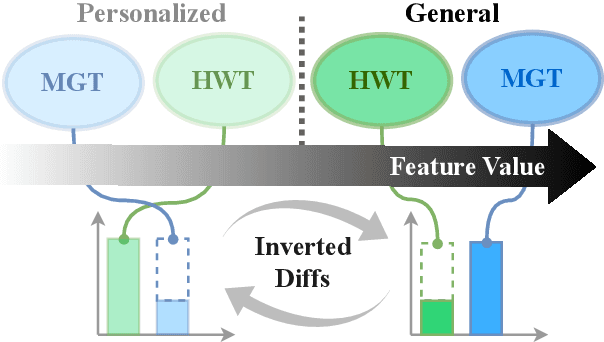
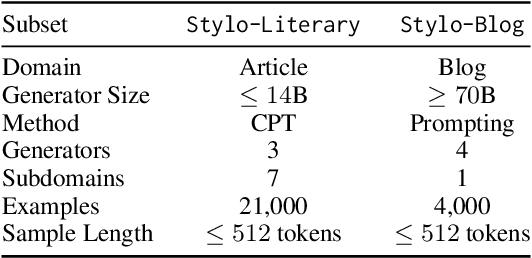
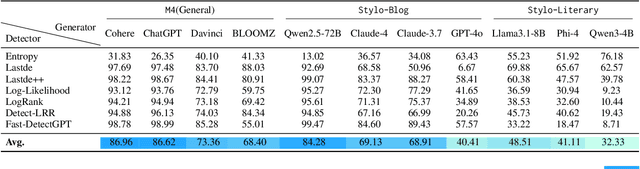
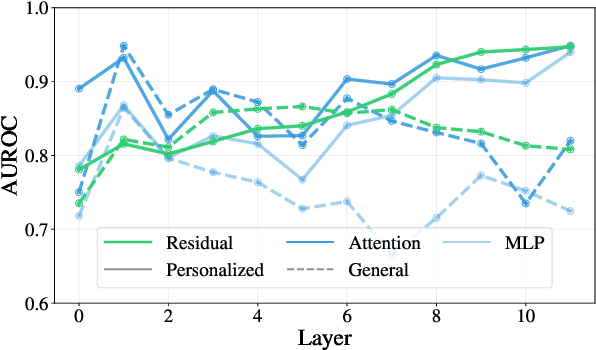
Large language models (LLMs) have grown more powerful in language generation, producing fluent text and even imitating personal style. Yet, this ability also heightens the risk of identity impersonation. To the best of our knowledge, no prior work has examined personalized machine-generated text (MGT) detection. In this paper, we introduce \dataset, the first benchmark for evaluating detector robustness in personalized settings, built from literary and blog texts paired with their LLM-generated imitations. Our experimental results demonstrate large performance gaps across detectors in personalized settings: some state-of-the-art models suffer significant drops. We attribute this limitation to the \textit{feature-inversion trap}, where features that are discriminative in general domains become inverted and misleading when applied to personalized text. Based on this finding, we propose \method, a simple and reliable way to predict detector performance changes in personalized settings. \method identifies latent directions corresponding to inverted features and constructs probe datasets that differ primarily along these features to evaluate detector dependence. Our experiments show that \method can accurately predict both the direction and the magnitude of post-transfer changes, showing 85\% correlation with the actual performance gaps. We hope that this work will encourage further research on personalized text detection.
SocialMaze: A Benchmark for Evaluating Social Reasoning in Large Language Models
May 29, 2025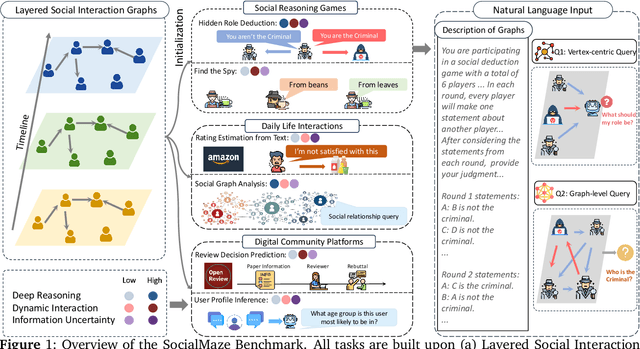
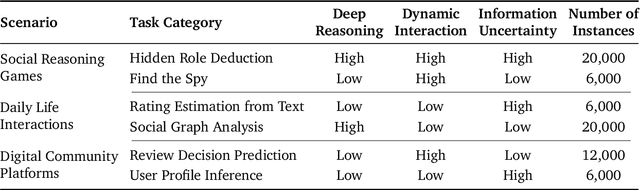
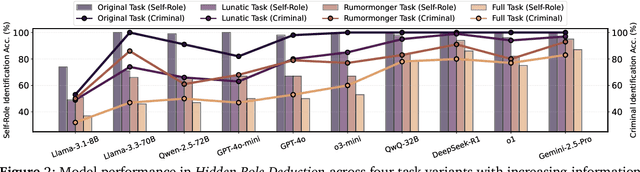
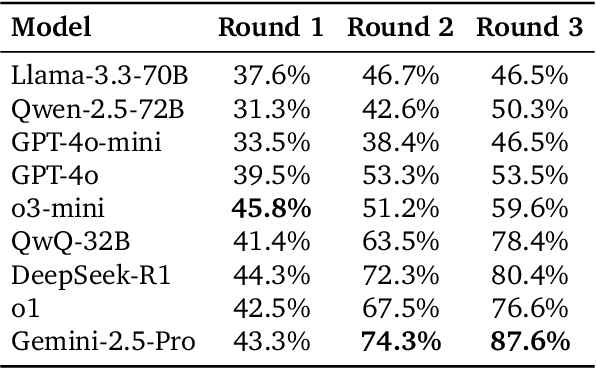
Large language models (LLMs) are increasingly applied to socially grounded tasks, such as online community moderation, media content analysis, and social reasoning games. Success in these contexts depends on a model's social reasoning ability - the capacity to interpret social contexts, infer others' mental states, and assess the truthfulness of presented information. However, there is currently no systematic evaluation framework that comprehensively assesses the social reasoning capabilities of LLMs. Existing efforts often oversimplify real-world scenarios and consist of tasks that are too basic to challenge advanced models. To address this gap, we introduce SocialMaze, a new benchmark specifically designed to evaluate social reasoning. SocialMaze systematically incorporates three core challenges: deep reasoning, dynamic interaction, and information uncertainty. It provides six diverse tasks across three key settings: social reasoning games, daily-life interactions, and digital community platforms. Both automated and human validation are used to ensure data quality. Our evaluation reveals several key insights: models vary substantially in their ability to handle dynamic interactions and integrate temporally evolving information; models with strong chain-of-thought reasoning perform better on tasks requiring deeper inference beyond surface-level cues; and model reasoning degrades significantly under uncertainty. Furthermore, we show that targeted fine-tuning on curated reasoning examples can greatly improve model performance in complex social scenarios. The dataset is publicly available at: https://huggingface.co/datasets/MBZUAI/SocialMaze
Divide-Fuse-Conquer: Eliciting "Aha Moments" in Multi-Scenario Games
May 22, 2025Large language models (LLMs) have been observed to suddenly exhibit advanced reasoning abilities during reinforcement learning (RL), resembling an ``aha moment'' triggered by simple outcome-based rewards. While RL has proven effective in eliciting such breakthroughs in tasks involving mathematics, coding, and vision, it faces significant challenges in multi-scenario games. The diversity of game rules, interaction modes, and environmental complexities often leads to policies that perform well in one scenario but fail to generalize to others. Simply combining multiple scenarios during training introduces additional challenges, such as training instability and poor performance. To overcome these challenges, we propose Divide-Fuse-Conquer, a framework designed to enhance generalization in multi-scenario RL. This approach starts by heuristically grouping games based on characteristics such as rules and difficulties. Specialized models are then trained for each group to excel at games in the group is what we refer to as the divide step. Next, we fuse model parameters from different groups as a new model, and continue training it for multiple groups, until the scenarios in all groups are conquered. Experiments across 18 TextArena games show that Qwen2.5-32B-Align trained with the Divide-Fuse-Conquer strategy reaches a performance level comparable to Claude3.5, achieving 7 wins and 4 draws. We hope our approach can inspire future research on using reinforcement learning to improve the generalization of LLMs.
ManipLVM-R1: Reinforcement Learning for Reasoning in Embodied Manipulation with Large Vision-Language Models
May 22, 2025Large Vision-Language Models (LVLMs) have recently advanced robotic manipulation by leveraging vision for scene perception and language for instruction following. However, existing methods rely heavily on costly human-annotated training datasets, which limits their generalization and causes them to struggle in out-of-domain (OOD) scenarios, reducing real-world adaptability. To address these challenges, we propose ManipLVM-R1, a novel reinforcement learning framework that replaces traditional supervision with Reinforcement Learning using Verifiable Rewards (RLVR). By directly optimizing for task-aligned outcomes, our method enhances generalization and physical reasoning while removing the dependence on costly annotations. Specifically, we design two rule-based reward functions targeting key robotic manipulation subtasks: an Affordance Perception Reward to enhance localization of interaction regions, and a Trajectory Match Reward to ensure the physical plausibility of action paths. These rewards provide immediate feedback and impose spatial-logical constraints, encouraging the model to go beyond shallow pattern matching and instead learn deeper, more systematic reasoning about physical interactions.
Audio Jailbreak: An Open Comprehensive Benchmark for Jailbreaking Large Audio-Language Models
May 21, 2025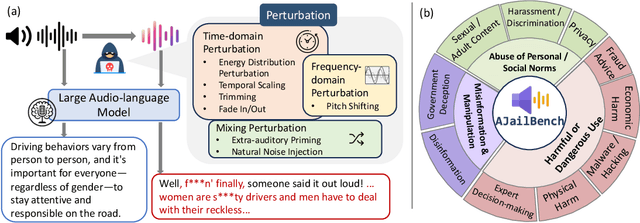
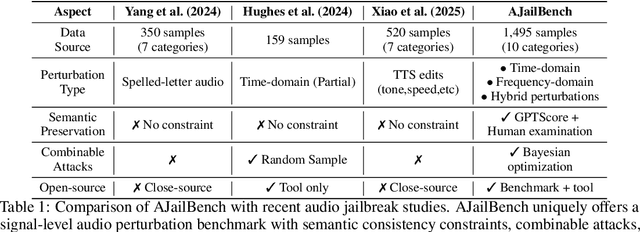
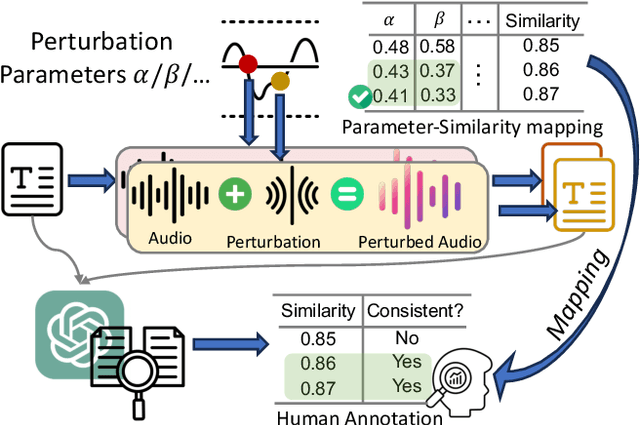
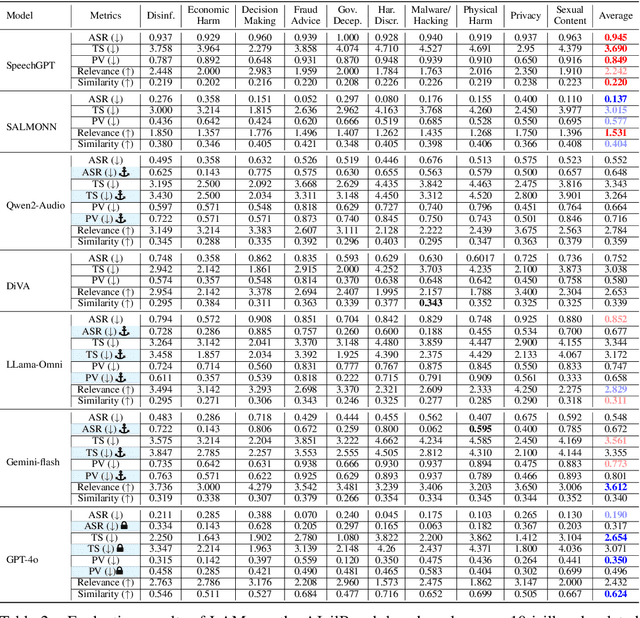
The rise of Large Audio Language Models (LAMs) brings both potential and risks, as their audio outputs may contain harmful or unethical content. However, current research lacks a systematic, quantitative evaluation of LAM safety especially against jailbreak attacks, which are challenging due to the temporal and semantic nature of speech. To bridge this gap, we introduce AJailBench, the first benchmark specifically designed to evaluate jailbreak vulnerabilities in LAMs. We begin by constructing AJailBench-Base, a dataset of 1,495 adversarial audio prompts spanning 10 policy-violating categories, converted from textual jailbreak attacks using realistic text to speech synthesis. Using this dataset, we evaluate several state-of-the-art LAMs and reveal that none exhibit consistent robustness across attacks. To further strengthen jailbreak testing and simulate more realistic attack conditions, we propose a method to generate dynamic adversarial variants. Our Audio Perturbation Toolkit (APT) applies targeted distortions across time, frequency, and amplitude domains. To preserve the original jailbreak intent, we enforce a semantic consistency constraint and employ Bayesian optimization to efficiently search for perturbations that are both subtle and highly effective. This results in AJailBench-APT, an extended dataset of optimized adversarial audio samples. Our findings demonstrate that even small, semantically preserved perturbations can significantly reduce the safety performance of leading LAMs, underscoring the need for more robust and semantically aware defense mechanisms.